

PASSEGGIATA TABUCCHI 2
A WALK WITH TABUCCHI 2
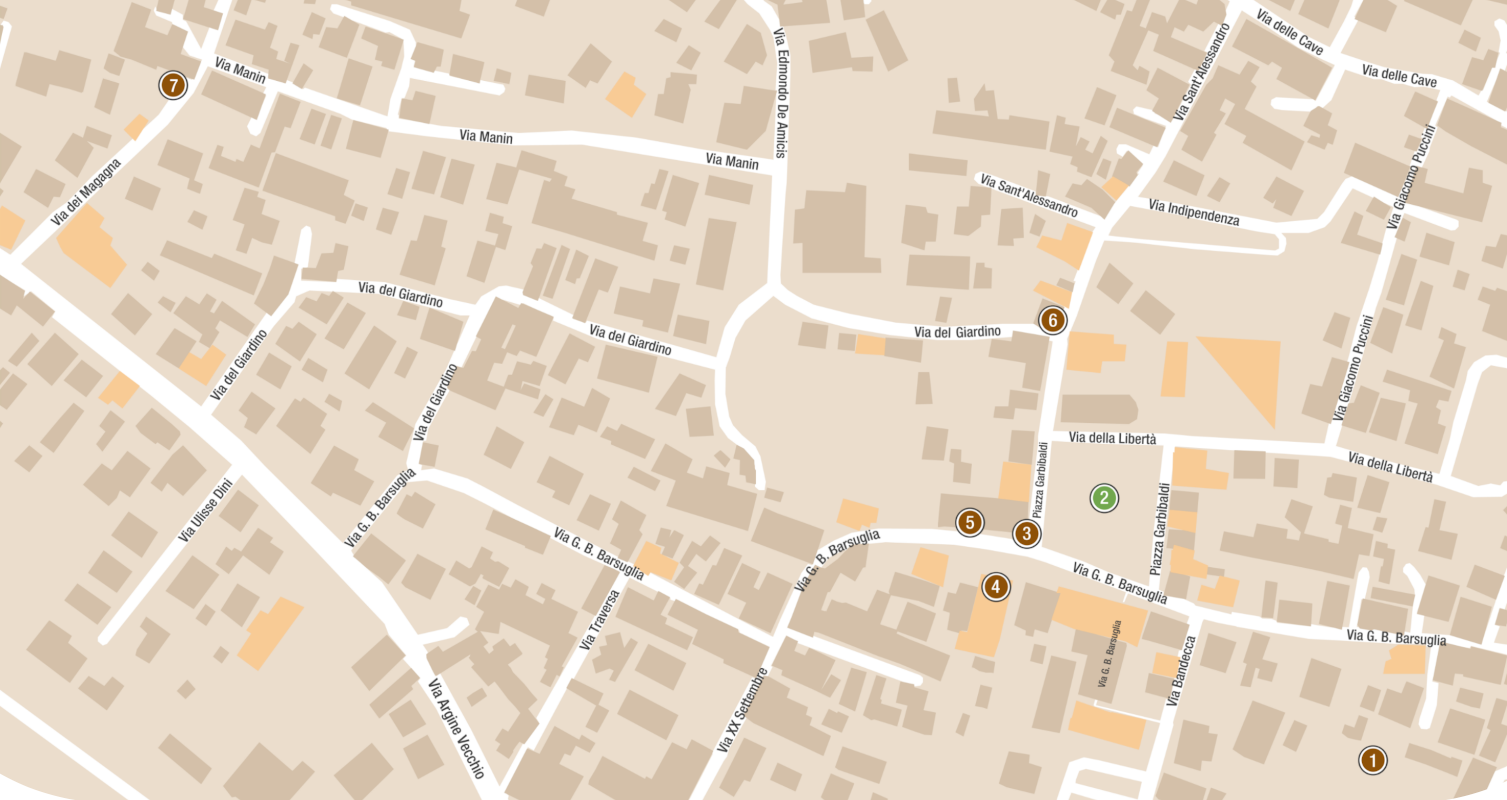
Piazza Garibaldi
Piazza Garibaldi, central to the life of the Vecchianese community, played an important role in the writer's youthful imagination, so much so that it became the protagonist of his first novel, Piazza d’Italia (1975). This is the story of a Tuscan village and its inhabitants in the historical period that runs from the unification of Italy to the early sixties of the twentieth century. The events narrated in the novel, are extracted from the life of a family whose Garibaldian ideals go from generation to generation, intertwining with the life of the village.
The current name of the square probably dates as far back as the early twentieth century when a statue of Garibaldi was built to be placed in the village center. According to some Vecchianesi, including Piero Chicca, this statue was considered so ugly that it was demolished by popular acclaim. A second statue was thus erected but was destroyed during the 1944 bombings. Finally, a third statue, smaller in size, was placed on the pre-existing base and it still stands in the center of the square.
During the reign of Mayor Emilio Spinesi’s Administration, this once unpaved area which was used as a parking lot, was redesigned in the late 1980s but its construction was carried out by the administration of Giancarlo Lunardi. In April 2012, the Municipal Administration decided to add the wording “Piazza d’Italia” to the official toponymy as a tribute to the famous novel.
Tabucchi’s maternal house overlooks the square, at the intersection with Via Barsuglia, and it is from its windows that the writer learned to look at the world. We can therefore hypothesize that he, then very young, was fascinated not only by Garibaldi’s epic, but also by the concrete and pulsating life of the square, where anarchist and traditionally deeply rooted republican ideals circulated. Thus, transfigured by the narrative language, the square becomes an emblem of the life of a community and its transformations over time. The same author underlined, in an interview in May 2011, the importance of squares within the life of cities and towns:
«In the Italian and Western European culture The Square is a fundamental meeting place, not only a monumental but also a symbolic place. We go to the square. […] Having a center […] allows us to mentally have a geography of ourselves and of the place we live in. […]. In our ontological town planning, we Italians […], […] need a centre.»
It is here in Piazza Garibaldi, or better, Piazza d’Italia that each character of the novel goes through the important stages of their personal story. These personal stories intersect with History as they witness the subsequent inaugurations of monuments that gradually accompany and unveil the Unification of Italy, the rise and fall of Fascism, as well as the birth of the Republic; monuments which, with each change, will then be demolished with fury.
The square, therefore, can be seen as a theatre where the community represents itself, not only through major events, but also through the tiniest of individual stories. The square is thus a multipurpose place. It is at the same time a historical, economic, social and ritual place that becomes a mirror reflecting the history of our country between the nineteenth and twentieth centuries.
(Traduzione di Maria Blandino)