

PASSEGGIATA TABUCCHI 7
A WALK WITH TABUCCHI 7
Casa Tabucchi
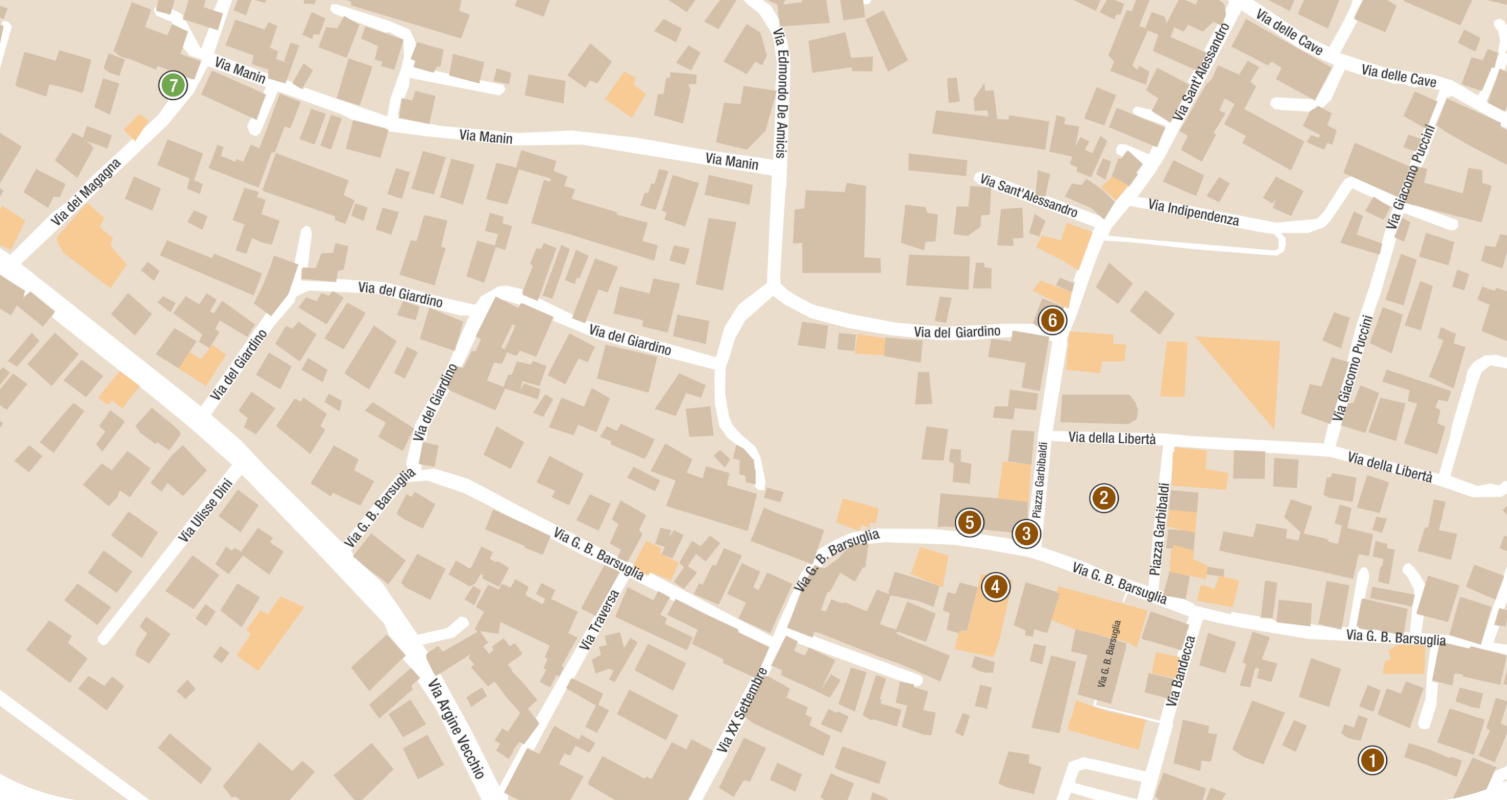
Via dei Magagna, 21 (ora 25)
In September of 1943 Antonio Tabucchi was taken by his parents to the house of his paternal grandparents in via dei Magagna in Vecchiano. He had been born just before at the Santa Chiara hospital in Pisa, but at that time the town of Pisa was under intense allied bombing attacks. As well as passing his early childhood here, Antonio returned to live as an adult in this house when his daughter, Teresa, was born. Together with his wife, Maria José, and their first son, Michele, they left their house in via Trieste in Pisa, which had become too small for them. The house in Vecchiano, on the other hand, was spacious, with room for all the family and for a study, and the children could grow up in the countryside. At the entrance to the garden there were two big plane trees and Antonio planted a lemon tree, which he always remained fond of.
The inside of the building was organised on two floors, upstairs the bedrooms and downstairs the living area and study, just as it is today: shelves, carpets, large tables, a cupboard, and an antique 'madia', originally used for making bread. The dining table in the living room was a cheerful bright green colour with matching chairs, and this is where, even today, the members of the Association dedicated to the writer gather.
It was from via dei Magagna that Antonio and Maria José started out on their trips to Portugal and then the whole world, and to here that they returned ready to plan new adventures, or to take refuge amongst their books, gathering memories of a lifetime, pictures, pottery, and soon also plaques and prizes. This house preserves not only the private dimension of a family's life but also a story of literary and academic success and the friendship of those important artists with whom Tabucchi was lucky enough to work.
This place is also the workshop of the craftsman, the artist's studio. In the study there is a long desk where Tabucchi drafted many of his writings, but not Sostiene Pereira, which was written standing at the 'madia' in the dining room, between the beginning of July and the 25th. of August 1993. And then the books and the library which has spilled out into every room. In Antonio's study there is a large bookcase with glass doors, and here we find a collection of foreign literature, organised according to the various languages, (French, Spanish, South American, English, American, German, Russian, Japanese, etc.) Along the length of another wall there is an open bookcase for the Italian classics and for History and Philosophy and then another smaller section for Music and Cinema. Behind the desk, which is made of a light coloured wood, are the Dictionaries, the Battaglia and the Morais (Portuguese) in several volumes, works of some more favourite author, Conrad, for example, and then the translations of his own books in so many languages. But the shelves which contain the richest collection are still, nonetheless, those for Poetry, with the works of poets from all over the world.
In the entrance hall, however, above a beautiful wardrobe in walnut, you will find the elegant shelves, designed by the architect Pietro Ferri, containing the Italian novels of the twentieth century and, on another wall, all the prose. Between the dining room and the entrance yet another set of shelves holds magazines, and a whole series of guidebooks to different countries, cities and museums. Antonio loved guidebooks and had more than one for each country. Turning toward the kitchen, when you least expect it, right behind the door, there is the parchment document of one of the most important awards received: the “Médicis Etranger”, awarded in France thanks to “Notturno Indiano”, proves that the high and the low can live together within the tiny space of a homely dining room.
This house, far from being a museum or the storeroom for some 'tempo perduto', still has the fascination of a literary workshop while at the same time preserving the family atmosphere that it had when filled with the lives of grown-ups and children, as, for example, the study of Maria José, known by friends as “Zé”, where there is the television and stereo, and where for years the family watched together a film or some Tv programme that they all liked, ranging from sophisticated cinema to some variety show by Renzo Arbore; all under the indulgent eye of Fernando Pessoa who pops his head around the door from time to time.
(Traduzione di John Ayers, supervisore)